
FluidFlow Liquid Module: The Complete Guide to Incompressible Pipe Flow Simulation
Liquid piping systems are the circulatory system of industrial plants. Whether it’s cooling water flowing through a power plant, crude oil moving through refinery offsite piping, or purified water circulating through a pharmaceutical loop, getting the hydraulics right matters. Not just at startup, but across every operating scenario over the life of the plant.
The FluidFlow Liquid Module is purpose-built for this challenge. It handles incompressible, Newtonian fluid flow across networks of any complexity, from a simple pump-and-pipe circuit to a branching, multi-loop distribution system with dozens of control points.
This article covers what the module does, how it works, and why engineers across power generation, oil and gas, chemical processing, pharmaceutical, marine, and mining industries rely on it for critical liquid system design.
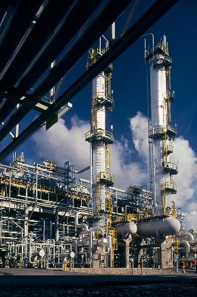
Image 1 – Complex industrial pipe networks require more than spreadsheet calculations to design and troubleshoot accurately.
What Is the FluidFlow Liquid Module?
The Liquid Module is the foundational calculation engine within FluidFlow’s pipe flow simulation platform. It performs steady-state hydraulic analysis of incompressible Newtonian fluids, calculating system operating pressures, flow distribution, pump operating points, heat transfer effects, and equipment sizing across entire pipe networks simultaneously.
Unlike isolated pipe calculators or spreadsheet methods, FluidFlow models the complete network. Every pipe, pump, valve, fitting, heat exchanger, and boundary condition is part of a single interconnected model. Solve once and get the full hydraulic picture of your system.
Core Capabilities
1. Flexible Friction Loss Methods
Pressure drop calculation accuracy depends on using the right friction model for your application. The Liquid Module supports four established methods:
- Darcy-Weisbach (Moody): the industry-standard method for most liquid applications, based on the Colebrook-White equation for friction factor
- Hazen-Williams: widely used for water distribution systems, particularly in civil and municipal engineering
- Shell-MIT: preferred for viscous liquids and crude oil transport applications
- Fixed friction factor: for cases where a predetermined value is appropriate
Engineers can apply the method most appropriate for their fluid and application, rather than being constrained to a single calculation approach.
2. Pump Analysis and Sizing
The Liquid Module provides comprehensive centrifugal and positive displacement pump analysis:
- Size new pumps based on system duty requirements
- Import and evaluate manufacturer pump curves against the actual system resistance curve
- Identify the operating point (flow rate and head) where the pump curve intersects the system curve
- NPSH analysis: real-time Net Positive Suction Head assessment to identify and prevent cavitation risk
- Multiple pump configurations: series and parallel pump arrangements with automatic performance blending
When a proposed pump selection does not meet the duty requirement, or when an existing pump is operating outside its design envelope, FluidFlow surfaces this directly in the model results.
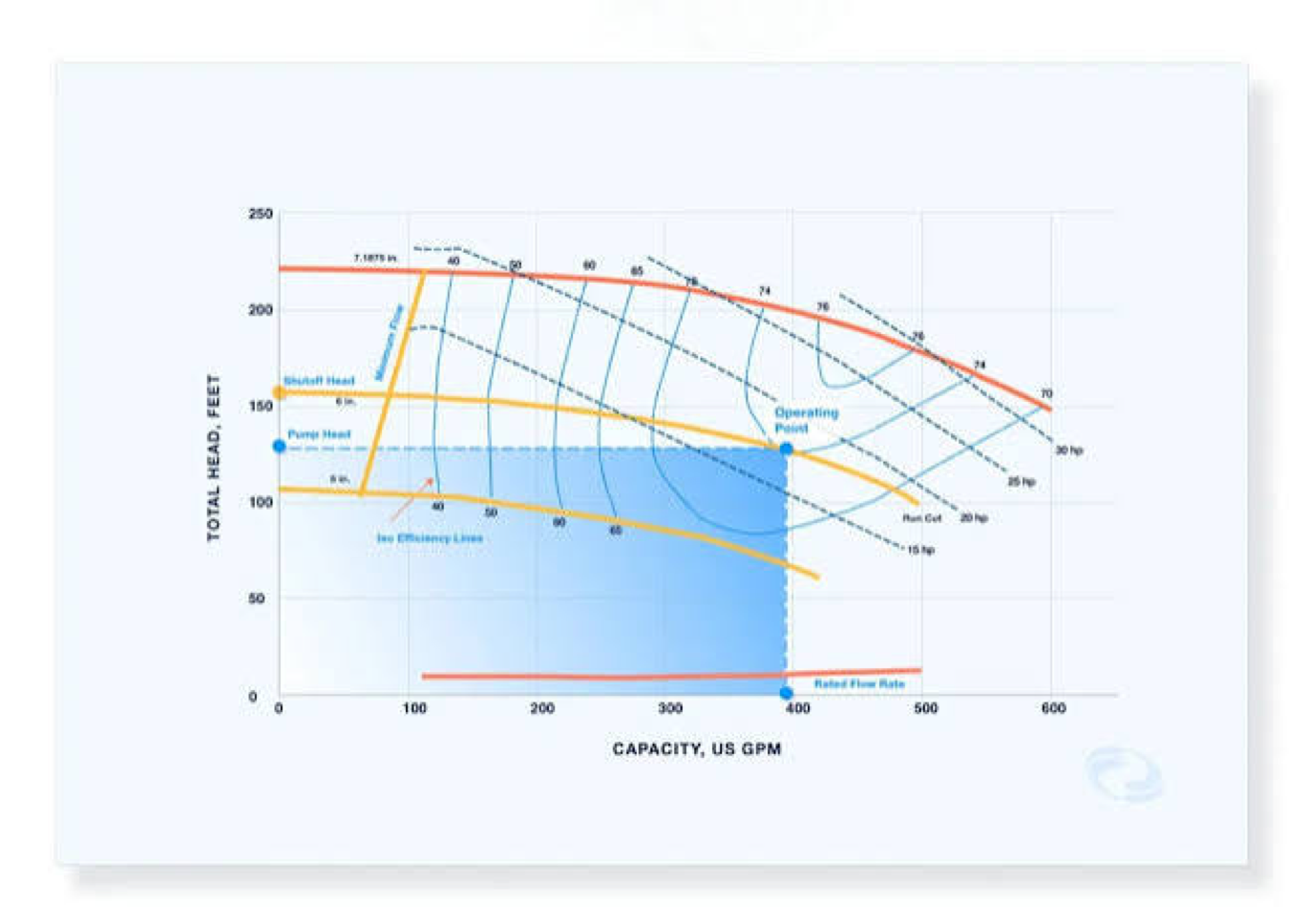
Image 2 – FluidFlow evaluates pump operating points against system resistance curves, including NPSH analysis to prevent cavitation.
3. Economic Pipe Sizing
Determining the right pipe diameter is not just about velocity rules of thumb. The Liquid Module uses the Generaux Equation for economic pipe sizing, balancing capital cost (larger pipe = higher material cost) against operating cost (smaller pipe = higher energy cost from friction losses) to propose the most cost-effective diameter for each line.
Three sizing criteria are available:
- Economic velocity (capital vs. energy cost optimization)
- Maximum velocity (process or erosion limits)
- Maximum pressure gradient (allowable pressure loss per unit length)
This turns pipe sizing from a judgment call into a defensible, auditable engineering calculation.
4. Integrated Thermal Modeling
Process fluid temperature affects viscosity, density, vapor pressure, and NPSH, all of which influence hydraulic performance. The Liquid Module simulates heat loss and gain along the flow path, accounting for:
- Pipe insulation type and thickness
- Buried piping with soil thermal properties
- Ambient temperature conditions
- Fluid thermal properties that vary with temperature
The result is a coupled thermo-hydraulic model rather than two separate calculations. Temperature profiles update the fluid properties, and fluid properties feed back into the pressure drop and pump operating point calculations.
Thermal modeling in FluidFlow accounts for insulation, burial conditions, and ambient temperature effects on fluid properties.
5. Flow Balancing Across Complex Networks
In branching and looped systems, flow distributes according to the pressure balance across every path. Getting this right, ensuring each branch receives its design flow, is one of the more tedious tasks in liquid system design.
FluidFlow solves the entire network simultaneously using a rigorous matrix solver, automatically distributing flow to satisfy continuity and pressure balance at every node. The engineer can then review the distribution, adjust orifice plates or control valves, and re-solve instantly.
Deltamarin, a leading marine engineering consultancy, reported eliminating pressure-reducing valves entirely on one project by using FluidFlow to properly balance nozzle flow distribution from the outset.
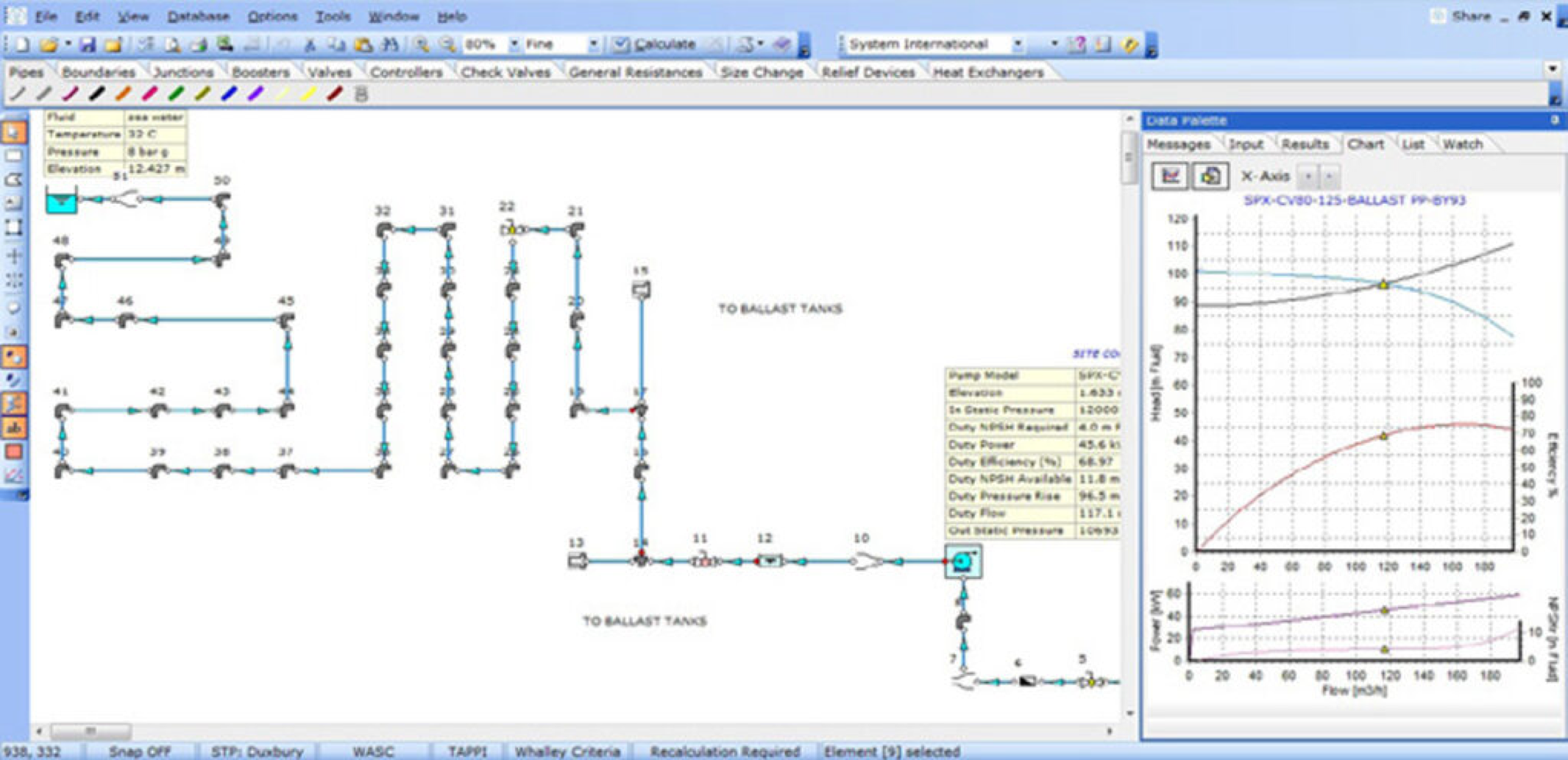
Image 3 – FluidFlow solves complete pipe networks simultaneously, showing flow rates, pressures, and velocities at every node and branch.
6. Aging Infrastructure Modeling
Real-world piping systems degrade over time. Scale buildup, internal corrosion, and surface roughness changes all increase friction factor and reduce flow capacity compared to as-built design conditions.
The Liquid Module accounts for:
- Adjusted pipe roughness values for corroded or scaled surfaces
- Pump wear and performance degradation
- Fouled heat exchangers
This makes FluidFlow useful not only for new design but for troubleshooting and rerating existing systems, diagnosing why a pump is operating off its curve or why a header that worked fine at startup is now undersupplied.
Advanced Analysis Tools
Back-Calc Analysis
Instead of specifying flow and solving for pressure, Back-Calc works in reverse: define a target condition at any point in the network (outlet pressure, required flow at a node) and FluidFlow calculates what equipment selection or operating parameter achieves it. This eliminates iterative manual trial-and-error.
Multi-Calc
Run multiple design scenarios simultaneously, varying pipe sizes, pump selections, valve settings, or operating conditions, and compare results side by side. Particularly useful for sensitivity analysis and design option evaluation.
Scripting for Dynamic Simulation
FluidFlow’s scripting interface extends beyond steady-state into time-dependent analysis, investigating system control philosophy, valve sequencing, pump startup and shutdown behavior, and dynamic pressure transients.
Professional Reporting
Results export to PDF and Excel in fully customizable report formats, including flowsheets that can be used for peer review, client submissions, and design audit trails. PCF (Piping Component File) import is also supported for integration with piping design tools.
Industry Applications
The Liquid Module is applied across a wide range of industries and system types.
Show Image From oil and gas refineries to pharmaceutical plants, the FluidFlow Liquid Module serves engineers across every process industry.
Oil and Energy Crude oil transport lines, water injection networks, boiler feedwater loops, refinery offsite loading, fuel oil distribution, and chemical injection packages. The integrated DIPPR fluid database covers the full range of hydrocarbon and process fluids.
Chemical Processing Transfer and loading systems, on-line mixing, recirculation networks, and branching flow systems with multiple pump and control valve interactions.
Pharmaceutical Purified water loops, jacketed vessel modeling, buffer solution preparation, API cooling circuits, and volatile solvent transfer, with sanitary velocity enforcement and flashing solvent monitoring for GMP-sensitive applications.
Marine Seawater cooling loops, lube oil circulation, firewater deluge systems, cargo discharge and loading, bilge and sludge pumping. Cochin Shipyard, one of India’s largest shipbuilders, uses FluidFlow extensively across engineering systems fleet-wide.
Mining Process water distribution, dewatering circuits, and ore hydrotransport (in combination with the Slurry Module for solid-liquid transport).
Power Generation Cooling water circuits, condensate return systems, boiler feedwater, and closed-loop cooling, including heat transfer effects through condensers and heat exchangers.
Accuracy and Quality Assurance
FluidFlow’s calculation methods are benchmarked against established reference publications including Crane TP-410, Idelchik, and Miller, as well as ISO and API standards for equipment sizing. The development team maintains over 300 QA test networks that are re-validated with every software release, and the company operates under ISO 9001 certification.
The software has been in continuous industrial use since 1984. That longevity reflects something important: it performs reliably enough that engineering organizations keep renewing, and stake real design decisions on its results.
What Engineers Actually Report
The most cited benefit is time. CoMo-Industrial Engineering, a Dutch EPC consultancy, measured an 80% reduction in hydraulic calculation time after switching from Excel-based workflows to FluidFlow, time that was reinvested in optimization rather than model-building.
A North American EPC firm (Tecsar) reported saving approximately $800,000 in capital on a single project by using FluidFlow to demonstrate that a proposed steam header expansion was unnecessary, redirecting that capital before construction began.
For Deltamarin, the ability to properly balance multi-nozzle flow distribution meant eliminating pressure-reducing valves from a marine system design entirely, simplifying the installation and reducing both capital cost and long-term maintenance exposure.
Getting Started
The Liquid Module is available as a standalone product or as part of FluidFlow’s full simulation suite. A 14-day free trial with full professional features, sample projects, and live engineering support is available at fluidflowinfo.com.
DConsulthink is an authorized FluidFlow reseller serving engineering organizations across Ontario and Eastern Canada. We offer product demonstrations, licensing, and onboarding support to help your team get productive quickly.
Contact us to arrange a live demonstration or discuss whether FluidFlow is the right fit for your liquid system design workflow.
DConsulthink | Engineering Software Solutions | dconsulthink.com